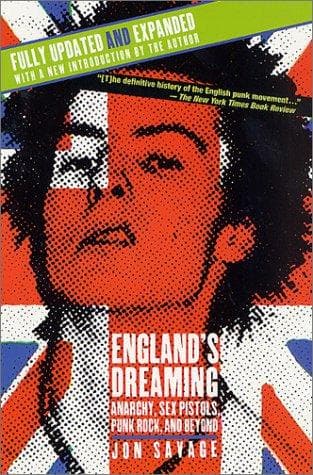
England's Dreaming

England's Dreaming

The definitive, forensic autopsy of the British punk movement and the socio-economic rot that birthed the Sex Pistols.

HS.UK
Author: The London Archives
Filed: 1991-10-21

The Architect of the Swindle

Jon Savage. The man who intellectualized the spit, the vomit, and the safety pins. Before 1991, punk existed merely as a messy, half-remembered fever dream of tabloid headlines and cheap speed. It remained a joke to the established rock press. A fad. A sneer. Then Savage dropped England’s Dreaming: The Sex Pistols and Punk Rock via Faber and Faber. Suddenly, the chaotic noise of 1976 was recast as a grand Situationist art project. Savage wasn’t just a fan with a typewriter. He was a hoarder. An archivist of the highest order. He had meticulously kept every fanzine, every interview tape, every grimy flyer from his early days as a music journalist writing for Sounds and Melody Maker. He even published his own fanzine, London's Outrage. He witnessed the scene first-hand but always maintained a cold, analytical distance. He wasn't a true believer. He was an observer. A spy in the house of noise. He eventually sold that massive archive in 2002 to Liverpool John Moores University. Probably made a killing. But in the late eighties, he utilized it to build an impenetrable fortress of hard facts.

The cultural climate of 1970s Britain was a post-war consensus dying a miserable, gray death. Garbage piled up in the streets. Strikes paralyzed the nation. The three-day week instituted under Edward Heath had left scars. Power cuts were frequent. Thatcherism loomed on the horizon like a storm front of pure malice. Savage captures this rot perfectly. He drills down into the suburban sado-masochism and the suffocating boredom of the era. The architecture of London wasn’t just brick and mortar. It was a psychological prison. Geographical specificity matters in this book. Bromley, Croydon, and Stevenage are depicted as concrete purgatories. The King's Road acted as a catwalk for the damned. Malcolm McLaren understood this reality better than anyone. He wanted to manipulate the human architecture of the city. He wanted to cause a riot.

Savage traces the rot back to its intellectual roots. He looks at the European avant-garde. The French Situationists. Lettrist International. Guy Debord’s Society of the Spectacle. He forces you to accept that the Sex Pistols were not an accident. They were a violent collision of high art theory and low-rent street violence. McLaren’s shop at 430 King's Road served as the epicenter. First it operated as Let It Rock, catering to Teds and 1950s nostalgia. Then it morphed into Too Fast to Live, Too Young to Die. Then SEX. Then Seditionaries. A revolutionary metaphor cleverly disguised as a boutique. McLaren famously rationalized his commercial instincts to the press.

"I'm excited by cults... that's why I opened Let it Rock. And now, the cults are the sex people. The leather people, rubber freaks, transvestites, shoe fetishists." — Malcolm McLaren, Curious Magazine, 1975

This wasn’t just about selling clothes. It was about selling chaos. Cash from chaos. Savage dissects the socio-economic conditions that allowed a sociopath like John Lydon to become a national anti-hero. The youth of Britain were utterly disenfranchised. Empty factories and dole queues awaited them. So they made "No Future" their battle cry. Savage's prose cuts through the cheap nostalgia. He doesn't romanticize the poverty. He weaponizes it. The decaying council estates. The miserable pubs. The sense of absolute, crushing defeat that permeated working-class life. This was the petri dish. The Pistols were the virus.

Savage's background as a Cambridge-educated writer equipped him with the analytical tools to elevate the discourse. He didn't just review the music. He psychoanalyzed the culture itself. He connected the dots between Richard Hell's ripped t-shirts in New York and the fetish gear sold by Vivienne Westwood in Chelsea. He maps out the intellectual lineage of punk, stripping away the myth of the 'noble savage' working-class kids spontaneously inventing a subculture out of thin air. It was curated. It was engineered. But it also spun wildly out of control, mutating into something neither McLaren nor Savage could have fully predicted or contained.

The Forensic Autopsy

The core thesis of England’s Dreaming remains simple but devastating. Punk was a controlled explosion that breached containment. Savage’s analysis of the Sex Pistols’ rise is entirely forensic. He dissects the internal power struggles. The manipulation by McLaren. The genius of Westwood’s designs. The brutal, raw talent of Steve Jones and Paul Cook holding the racket together while Lydon spat pure venom over the top. The book shatters the illusion of unity. There was no brotherhood here. It was a snake pit. McLaren viewed the musicians as mere mannequins for his clothing line and mouthpieces for his half-baked slogans. When Lydon started thinking for himself, the project was doomed.

One major revelation is the sheer level of intellectual calculation behind the outrage. The infamous Bill Grundy interview in December 1976 wasn't just a drunken mistake on live television. It was the inevitable result of McLaren pushing his volatile commodities onto a collision course with polite society. Savage meticulously details the fallout. The cancelled gigs. The media hysteria. The hypocrisy of the British press, who loudly condemned the musicians while happily exploiting them to sell millions of papers. The Anarchy in the U.K. tour became an absolute disaster of logistics. Every local council in the country rushed to ban the group, stoked by moral panic from figures like Mary Whitehouse. Savage dissects how the media created the monster they then pretended to be terrified of.

Then there is Sid Vicious. The tragic, pathetic figurehead of the whole doomed enterprise. Savage does not spare him. He paints Vicious not as a misunderstood romantic martyr, but as a victim of his own profound idiocy and the machinations of those around him. A walking t-shirt slogan who actually believed his own press clippings. The rapid descent into heroin addiction. The catastrophic American tour in 1978. The bleak, miserable end at the Chelsea Hotel. Savage treats the Vicious saga with cold, clinical detachment. It’s a coroner’s report on a cultural suicide.

Archive Snapshot

The author digs into the extraneous detail surrounding the core group. The Bromley Contingent. Siouxsie Sioux. Billy Idol. The hangers-on who would eventually mutate into the post-punk and New Romantic movements. Savage recognizes that the audience mattered just as much as the performers on stage. The boundary between performer and spectator completely dissolved. This was Situationism in bloody, real-time action. Kids didn't just watch the band; they emulated them, fought them, and formed their own groups the very next day.

The analysis of the music itself remains razor-sharp. Savage understands that Never Mind the Bollocks is not a crude, lo-fi punk record. It’s a massive, multi-tracked wall of sound produced by Chris Thomas. Thomas had previously worked with Pink Floyd. He brought that meticulous, layered obsession to the Pistols. The intense dissonance between the slick studio sound and the nihilistic lyrics is exactly what makes the album so potent. The irony of punk destroying dinosaur rock while utilizing its exact production techniques is a delicious contradiction Savage relishes.

Savage also tackles the sexual politics of the era. The androgyny. The aggressive, confrontational sexuality of the clothing. The shattering of traditional gender roles, however brief and incomplete that shattering may have been. He doesn't shy away from the ugly side. The swastikas. The flirting with fascism for cheap shock value. He doesn't excuse it. He contextualizes it as the ultimate taboo in a post-war society still deeply obsessed with the mythic Blitz spirit.

England’s Dreaming forces the reader to confront the reality that punk was a massive, walking contradiction. It positioned itself as fiercely anti-capitalist, yet remained utterly obsessed with fame and money. It claimed to be egalitarian, yet was completely dominated by egos and narcissists. It claimed to destroy rock and roll, but only ended up saving it from the bloated corpse of progressive rock. Savage charts this contradictory terrain with brutal honesty. He strips the romance away and leaves only the cold, hard facts. The gigs that nobody attended but everyone lied about being at. The recording sessions fueled by amphetamines and spite. The inevitable collapse.

The Aftermath and the Arguments

Thirty years after its 1991 publication, England’s Dreaming remains the immovable monolith of punk literature. Charles Shaar Murray called it "a hole-in-one, grand-slam knockout of a book." He wasn't wrong. It won the Ralph J. Gleason Music Book Award. It set the gold standard. Every single book written about punk since is either stealing from Savage or furiously arguing with him.

The legacy is profound. Before Savage, music history consisted mostly of ghostwritten autobiographies and hagiographic fan letters. England's Dreaming proved that pop culture could be treated with the exact same academic rigor as the fall of the Roman Empire. It validated the entire discipline of cultural studies. It proved that trash culture mattered. That a three-minute pop song about anarchy could function as a legitimate, serious historical document.

But it’s not without severe controversy. Many of the original participants hate the book. John Lydon has frequently dismissed it as bourgeois nonsense. The street-level kids actively resent Savage’s academic approach. They argue that he intellectualized something that was purely visceral. That he superimposed high-minded French philosophy onto bored teenagers who were merely trying to get laid and get drunk. They accuse him of giving far too much credit to McLaren and the art school crowd, and not nearly enough to the working-class kids who actually made the noise.

There is absolute truth to that accusation. Savage is a product of his education. He prefers the high-concept theory to the low-brow reality. But without that framework, punk is just a minor footnote. A fashion trend that lasted eighteen months. Savage built the mythology that allowed punk to survive the decades. The 2002 sale of his archive proved that punk was now an academic subject, safely locked behind glass. The rebellion had been fully commodified and institutionalized. He later moved on to write Teenage: The Creation of Youth Culture, realizing that punk was merely the terminal point of a process that started in the 1940s.

The impact on subsequent generations of writers is massive. You can draw a straight line from England's Dreaming to Simon Reynolds' Rip It Up and Start Again or John Robb's Punk Rock: An Oral History. It defined the template for the serious music book. It also shaped how documentaries are constructed. The 2000 film The Filth and the Fury had to violently grapple with the narrative Savage established.

The 2021 reissue, featuring a foreword by Johnny Marr and an introduction by Jeremy Deller and Scott King, only cemented its legendary status. It proved that the text remains chillingly relevant. Modern readers approach the book differently. It feels less like history and more like a prophecy. The grim, divided, striking Britain of 1976 looks suspiciously like the Britain of today. The socio-economic conditions Savage described—the poverty, the right-wing resurgence, the sense of hopelessness—are terrifyingly familiar. The book is not just a history lesson. It’s a warning.

Savage captured the exact moment when youth culture stopped being innocent. Punk was the violent death of the 1960s hippie dream. It was the harsh, abrasive dawn of the modern era. England's Dreaming is the definitive autopsy report. It doesn’t ask you to like the Sex Pistols. It demands that you understand them. It insists that the chaos had meaning. Even if that meaning was just a reflection of the profound ugliness of the society that birthed them.

"Malcolm says that he sometimes buys cakes and Coke to give to his customers. Thinking that 'Capitalism stinks', he has doubts about running the shop." A pathetic admission of guilt from the architect of the swindle.

The Personnel

  • Jon Savage: The hoarder. The academic. The man who wrote the autopsy.
  • Malcolm McLaren: The Situationist swindler who sold chaos to the masses.
  • John Lydon (Johnny Rotten): The sociopathic anti-hero and primary vehicle for the venom.
  • Vivienne Westwood: The radical designer who dressed the rebellion in rubber and safety pins.
  • Sid Vicious: The tragic t-shirt slogan who believed his own myth.

Essential Discography

  • Sex Pistols - Never Mind the Bollocks, Here's the Sex Pistols (1977): The highly produced wall of sound that contradiction built.
  • Richard Hell and the Voidoids - Blank Generation (1977): The New York template that Westwood and McLaren cannibalized.
  • The Clash - The Clash (1977): The politicized counter-narrative to the Pistols' pure nihilism.
  • Siouxsie and the Banshees - The Scream (1978): The sound of the Bromley Contingent mutating into post-punk brilliance.

Archivist Notes: England's Dreaming

Absolutely. Written by Jon Savage, this book is considered a monumental piece of literature in the rock archive. It offers unfiltered access to the era and is a must-read for any serious collector.
HS

About The Helter Skelter Archive

We are dedicated to preserving the raw, unfiltered history of rock music. Rejecting modern sanitized narratives, our editorial desk digs into out-of-print fanzines, rare biographies, and the chaotic history of the artists who built the culture. No AI rewrites, no corporate spin.

Join The Underground

Get rare archival footage, out-of-print fanzine scans, and exclusive reviews delivered to your inbox.

No spam. Just pure rock history.