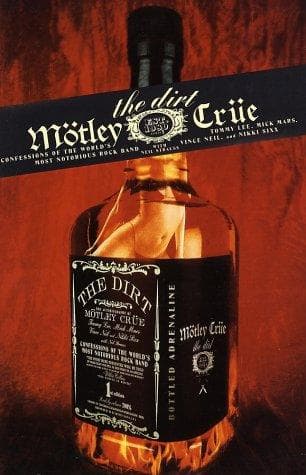
The Dirt: Confessions of the World's Most Notorious Rock Band
An autopsy of the 1980s hair metal scene and the definitive, disease-ridden text on Mötley Crüe.
Neil Strauss was never a Sunset Strip degenerate. He was a New York Times journalist. He wore sensible glasses. He analyzed culture with the detached, clinical precision of an entomologist pinning a particularly ugly moth to a corkboard. Yet, when HarperEntertainment commissioned him to co-write the autobiography of Mötley Crüe in the late 1990s, Strauss understood the assignment implicitly. He wasn’t there to write a hagiography. He was there to excavate the darkest, most disease-ridden corners of the 1980s hair metal scene and force its architects to stare into the abyss of their own making.
Before The Dirt: Confessions of the World's Most Notorious Rock Band dropped like a bag of wet cement on May 22, 2001, rock biographies were, largely, sanitised public relations exercises. Carefully curated mythologies designed to protect the corporate brand dominated the bookshelves. Ghostwriters completely glossed over the overdoses. Publicists obscured the violence. Managers pretended the rampant misogyny was just harmless boys being boys. Strauss obliterated that tired template. He approached Nikki Sixx, Tommy Lee, Vince Neil, and Mick Mars not as musical heroes, but as completely unreliable narrators in a grand, grotesque tragedy.
The cultural zeitgeist of 2001 was absolutely ripe for this specific brand of truth. The sanitized, corporate grunge of the late 1990s and the plastic pop of the TRL era had left a massive void in the market. People didn't want polished pop stars anymore. Audiences wanted trainwrecks. Consumers wanted blood. Readers wanted dirt. They wanted to know exactly what happened when the cameras stopped rolling.
The Strauss Interrogation
Strauss’s methodology was brutal and exact. He didn't just interview the musicians over coffee. He interrogated them relentlessly in hotel rooms. He played them off one another. He established a cardinal rule: no member could edit or veto another member's chapter. If Sixx remembered Tommy Lee acting like a spoiled, drug-addled brat during the Theatre of Pain sessions, that’s exactly how it went in the book. If Lee remembered Sixx as a paranoid, heroin-psychosis-driven tyrant, the text stayed. The resulting oral history structure is a masterclass in subjective truth. It operates as a Rashomon of absolute depravity. You are forced to read four conflicting accounts of the same car crashes, the same overdoses, the same acts of spectacular self-sabotage. You must piece together the ugly reality somewhere in the middle.
Before they met Strauss, Mötley Crüe had employed Tom Werman to produce their defining albums like Shout at the Devil (1983), Theatre of Pain (1985), and Girls, Girls, Girls (1987). Werman suffered through their absolute worst years of addiction, desperately trying to assemble coherent records out of heroin-soaked jam sessions. The musicians treated him terribly, a fact they recount in the book with a complete lack of remorse. Strauss uses these studio anecdotes not to celebrate their bad boy image, but to demonstrate the sheer, exhausting logistics of managing four addicts with a multi-million dollar recording budget. Werman’s experience, as detailed in the text, serves as a clear indictment of an industry that prized chart positions over basic human safety.
The 1980s Sunset Strip was a terrifying cultural anomaly. It functioned as a cocaine-fueled, neon-lit feedback loop of hyper-masculinity and profound, agonizing insecurity. Mötley Crüe didn't just survive the era; they defined its rotting core. By 2001, they were relics of a forgotten war. Vince Neil was carrying the permanent, crushing weight of vehicular manslaughter. Nikki Sixx had literally died and come back to life. Tommy Lee had endured real prison time and global public humiliation via a stolen sex tape. Mick Mars was slowly, agonizingly calcifying from ankylosing spondylitis.
Nobody had anything left to lose by telling the truth. Strauss knew exactly how to extract the poison. He didn't let anyone hide behind custom leather and flammable hairspray. He made the musicians confront the wreckage they caused. Publishers ReganBooks and HarperEntertainment were terrified. Manager Allen Kovac and the musicians had to legally indemnify the publisher against the inevitable lawsuits just to get the manuscript printed without heavy redactions. Executives knew what they were holding. It wasn’t a standard mass-market paperback. It was an unexploded ordnance.
A Rashomon of Depravity
Read The Dirt today, and it reads far less like a rock biography and significantly more like a police blotter written by Caligula. The core themes are not triumph over adversity or the redemptive power of rock music. The actual themes are untreated addiction, extreme clinical narcissism, severe emotional stuntedness, and survival through sheer, dumb luck. Strauss captures the terrifying momentum of a massive corporate enterprise that achieved global superstardom while its founders lacked the emotional maturity of a standard middle-schooler.
The revelations in the text are staggering. This isn't necessarily for their shock value—though there is plenty of that—but for the casual, almost bored tone with which the horrors are delivered. Nikki Sixx’s descent into black tar heroin addiction is documented with terrifying forensic detail. Descriptions of him hiding in a closet, consumed by drug-induced paranoia, armed with a loaded gun, convinced the SWAT team is coming for him, strip away any residual glamour associated with the junkie aesthetic. His infamous 1987 overdose, where he was pronounced dead before being revived by a paramedic with an adrenaline spike directly to the chest, is recounted not as a mystical near-death experience, but as a dirty, pathetic consequence of chronic, severe substance abuse.
Vince Neil’s chapters are, perhaps, the most chilling segments of the entire 430-page text. The December 1984 drunk driving car crash that killed Hanoi Rocks drummer Nicholas "Razzle" Dingley and left two other innocent people with severe brain damage remains a horrifying anchor in the narrative. Neil’s reflections on the event, his brief, cushy thirty-day incarceration, and the immediate push to get him back on the road to keep the million-dollar money machine rolling highlight the sociopathic machinery of the 1980s music industry. Strauss doesn't offer absolution for Neil. He lays bare the cold reality of wealth and white privilege buying a literal get-out-of-jail-free card. That specific horror resonates with nauseating clarity decades later.
Then there is the treatment of women. The Dirt operates as a grim, relentless catalogue of aggressive misogyny. Women in this book are currency. They are disposable commodities. They are collateral damage in a war they didn't sign up for. Interactions with groupies, girlfriends, and wives are chronicled with a brutal, unflinching honesty that is deeply uncomfortable to process in the modern era. The infamous closet story—where Sixx casually admits to tricking a woman into a sexual encounter under the completely false pretense that she was with Tommy Lee—is recounted with a disturbing, sociopathic lack of self-awareness. Years later, Sixx would desperately try to walk back this story. He claimed his drug-addled brain completely fabricated the event. Strauss printed it exactly as it was told to him during those original, tape-recorded sessions. This represents the absolute brilliance of the book. Strauss didn't act as a moral arbiter or a censor. He simply turned on the tape recorder, gave his subjects enough rope to hang themselves, and watched them eagerly oblige.
Mick Mars serves as the grim, silent, suffering anchor of the group. His specific chapters offer a stark, depressing contrast to the chaotic narcissism of the other three members. Battling ankylosing spondylitis—a highly painful, degenerative bone disease that he had publicly documented for years—Mars views the antics with a mixture of quiet disgust and weary resignation. He is the cynical observer trapped in a madhouse. He is the older musician who genuinely just wanted to play the guitar while the others were busy trying to kill themselves with narcotics and fast cars. His perspective grounds the text in a miserable reality. It provides a necessary, sobering counterweight to the relentless, exhausting hedonism of his bandmates.
The Cost of the Circus
The Dirt permanently altered the trajectory of music publishing. Before May 22, 2001, rock memoirs were largely ghostwritten vanity projects designed to sell more concert tickets. After Strauss published his findings, biographies had to actually bleed. The book spent weeks on the New York Times Bestseller list. It became the immediate blueprint for every subsequent musician’s autobiography. Everyone from Slash to Marilyn Manson tried to replicate its success in the ensuing decades. None captured the exact same alchemy of absolute moral bankruptcy and runaway narrative propulsion. It remains the gold standard for the genre because it committed fully to the absolute, unvarnished ugliness of its subjects. When Bob Rock dragged them into Little Mountain Sound Studios in Vancouver to record Dr. Feelgood, he forced them to get sober. Strauss did the exact opposite for the book. He forced them to remember the sickness.
"I was getting in the dirt... making sure they didn't just tell the stories they'd told a million times on MTV." — Neil Strauss
Other memoirs tried to follow the trail of destruction The Dirt left behind. Anthony Kiedis released Scar Tissue three years later, hoping to capture the same raw confession of drug abuse. Slash released his self-titled autobiography in 2007, detailing similar Sunset Strip excess. Yet, all of these subsequent books felt slightly calculated. They possessed a redemptive arc. The protagonist always got clean, learned a valuable lesson, and emerged as a better person ready to sell you a reunion tour ticket. The Dirt possessed absolutely zero interest in redemption. The final pages do not offer comfort. They offer a temporary ceasefire in a war that never truly ends. Strauss understood that a neat resolution would be a lie.
However, the legacy of the book is inherently, deeply toxic. Today, The Dirt stands as an unholy monument to the systemic abuse and misogyny that the music industry not only tolerated but wildly, financially celebrated. Stories that readers laughed at in 2001 are now scrutinized as admissions of assault, battery, and blatant sexual exploitation. The text forces a terrible, unresolvable reckoning. How do we consume art and history produced by people who operated with such flagrant, continuous disregard for human life and dignity?
The 2019 Netflix film adaptation attempted to severely sanitize some of these rougher edges. It turned a narrative of genuine, soul-crushing horror into a goofy, nostalgic frat-boy comedy. Director Jeff Tremaine completely missed the point of Strauss's original work. The book wasn't meant to be aspirational. It was a severe, flashing red warning. Even the film set was cursed with tragedy, resulting in a devastating lawsuit from a rigging grip named Louis DiVincenti, who suffered severe electrical burns during the sloppy production. The darkness always follows the brand.
The legal and personal fallout from the book and the continued existence of the subjects is a stark reminder of the unresolved trauma documented in its pages. Nobody ever truly escaped the personas they cemented in those chapters. The 2023 lawsuit filed by Mick Mars against his bandmates—alleging financial exploitation and an orchestrated, cruel campaign to force him out of the highly lucrative touring company due to his worsening illness—reads like a missing, depressing epilogue. The cruelty remains completely intact. The vicious infighting is identical. The ruthless prioritization of the corporate brand over basic human relationships is operating exactly as it did in 1987. The players are just significantly older. The lawyers are exponentially more expensive.
This book is a vital, putrid historical document. It captures the exact moment when the American music industry decided that total self-destruction was a highly marketable commodity. You do not read it to admire the musicians. You read it to survive them. You read it to understand the mechanics of a machine built entirely on the bones of its victims. It strips away the ridiculous, towering myth of the rock god and leaves behind absolutely nothing but the dirt. "They were exactly what you thought they were, and worse," Strauss once remarked.
The Personnel
- Neil Strauss – Co-author, instigator, archivist of the damned.
- Nikki Sixx – Bassist, primary songwriter, architect of his own near-demise.
- Tommy Lee – Drummer, percussionist, chaotic neutral energy centre.
- Vince Neil – Vocalist, driver during the 1984 tragedy.
- Mick Mars – Guitarist, silent observer, victim of corporate ousting.
Essential Discography
- Too Fast for Love (1981)
- Shout at the Devil (1983)
- Theatre of Pain (1985)
- Girls, Girls, Girls (1987)
- Dr. Feelgood (1989)
Archivist Notes: The Dirt: Confessions of the World's Most Notorious Rock Band
About The Helter Skelter Archive
We are dedicated to preserving the raw, unfiltered history of rock music. Rejecting modern sanitized narratives, our editorial desk digs into out-of-print fanzines, rare biographies, and the chaotic history of the artists who built the culture. No AI rewrites, no corporate spin.
Join The Underground
Get rare archival footage, out-of-print fanzine scans, and exclusive reviews delivered to your inbox.
No spam. Just pure rock history.