The Story of Crass: A Brutalist Autopsy of Anarcho-Punk
A cynical, definitive dissection of the most dangerous band in Thatcher's Britain, stripping away the mythology of DIY culture.
George Berger did not emerge from a vacuum of sterile academic publishing. He was a creature of the very dirt he sought to document. A freelance music journalist scribbling for Sounds and Melody Maker, Berger possessed a distinctively grim perspective on late 20th-century British subcultures. He understood that the punk scene, widely mythologized as a spontaneous working-class revolt, had rapidly degenerated into a cartoonish farce. The Bromley Contingent and the King’s Road posers were the mainstream darlings. The Sex Pistols were effectively a boy band managed by a boutique owner. The Clash signed to CBS. This was the cultural malaise that gripped Britain in the late 1970s. Punk was dead before it even breathed. Against this backdrop of corporate co-option and superficial safety pins, true radicalism required absolute, uncompromising isolation. It required Dial House.
Berger's documentation of Crass, therefore, required him to navigate a historical minefield. He could not merely write a glowing hagiography. He had to dissect the socio-political conditions that necessitated a band like Crass. 1977 was a miserable time to be alive in London. Unemployment in the UK was soaring. The Winter of Discontent loomed. James Callaghan's Labour government was failing, paving the bloody road for Margaret Thatcher's ruthless neoliberal crusade. The streets were fraught with National Front thugs and heavy-handed police tactics. Mainstream music offered escapism. Mainstream punk offered a diluted, marketable rebellion. Crass offered a brick through the window. Berger understood this intrinsic distinction. His background as a participant in the fringes of these subcultures allowed him access where traditional biographers would have been laughed out of the room. He didn’t just observe the anarcho-punk movement. He breathed its stale, cider-soaked air.
Omnibus Press unleashed The Story of Crass onto a largely unsuspecting public in 2006. It was a bizarre era. The early 2000s saw a renewed, highly sanitized commodification of punk rock. Green Day and Blink-182 dominated television screens. The word anarchy was printed on mass-produced garments sold in brightly lit shopping malls. Berger’s text arrived as a necessary corrective. A harsh slap to the face of historical revisionism. It reminded everyone that true anarchy was not a fashion statement. It was a lived reality. It was Penny Rimbaud and Gee Vaucher operating an open-house commune in Essex, self-publishing zines, pressing their own records, and living entirely outside the capitalist structure. Berger’s task was monumental. He had to capture the sheer, unadulterated noise of a collective that rejected every convention of the music industry. He succeeded by stripping away the mythology and focusing on the raw mechanics of their existence. The result is a biography that feels less like a narrative and more like an autopsy of a failed, yet glorious, revolution. The author's proximity to the subject matter is a double-edged sword, obviously. Some critics noted his occasional lapses into fawning admiration. Others pointed out that his prose could be disjointed. Scrappy. Unpolished. But what the hell did they expect? A polite, academic treatise on a group that literally squatted on the fringes of society? Berger’s rough-hewn style mirrors his subject perfectly. He does not aim for elegance. He aims for blunt force trauma.
Cultural necessity dictated the existence of this book. Before Berger's intervention, the history of anarcho-punk was largely relegated to self-published zines and fragmented internet forums. There was no cohesive, definitive historical record. The mainstream music press ignored Crass, partly out of snobbery, but mostly out of fear. Crass did not play the game. They refused to send out promo copies. They rejected press junkets. They actively antagonized journalists. Berger, having survived the trenches of the British music press, was perhaps the only writer equipped to bridge this gap. He possessed the necessary cynical edge. He understood that the story of Crass was not just a story about music. It was a story about class warfare, state surveillance, and the desperate, doomed attempt to create an autonomous zone within a hyper-capitalist society. The cultural context leading up to the book’s publication demanded a voice that could cut through the nostalgia. Berger provided that voice, even if it occasionally cracked under the weight of its own ambition. He gave the movement its first real historical anchor.
The Dial House Autopsy
Berger cuts straight to the bone. The Story of Crass refuses to engage in the typical rock biography tropes. Readers will not find tedious chapters about childhood trauma or musical epiphanies. Instead, the narrative is anchored entirely around Dial House, the 16th-century cottage in Essex that served as the beating heart of the Crass operation. This isn't just a physical location. It is the central ideological pillar of the book. Berger meticulously details how Dial House functioned as an open commune, a radical art collective, and a sovereign state defying Thatcher's Britain. The revelation here isn't merely that these individuals cohabitated. It is the rigid, almost monastic discipline they imposed upon themselves to maintain their autonomy. The DIY ethic is a core theme, but Berger elevates it from a stylistic choice to a sheer survival mechanism. Crass didn't just release their own records. They printed their own sleeves. They organized their own tours. They fed their audiences. They operated entirely outside the established industrial complex.
Oral history forms the structural spine of the text. Extensive interviews with Penny Rimbaud, Steve Ignorant, and Gee Vaucher dominate the pages. This is where Berger hits his absolute stride. He allows the contradictions within the band to fester on the page. Rimbaud emerges as the austere, intellectual architect of the movement. Ignorant is the street-level voice, the working-class conduit for Rimbaud's verbose manifestos. Vaucher is the silent, brilliant visual anchor, her stark collage art defining the entire anarcho-punk aesthetic. The internal tensions between these figures are laid bare. Berger does not shy away from the inherent hypocrisy of a rigid anarchist collective. The revelation that Rimbaud often acted with dictatorial authority over a group ostensibly dedicated to absolute freedom is a bitter pill. It shatters the utopian myth. Crass were flawed, argumentative, and frequently miserable. Their commitment to the cause cost them their personal relationships, their mental health, and eventually, their cohesion.
"We were looking for a way out of the madness, but we just ended up building our own asylum in the middle of Essex." — Steve Ignorant, as quoted in The Story of Crass
Political warfare is excavated with clinical precision by Berger. The infamous "Thatchergate" tape is given its proper historical weight. Crass spliced together audio of Margaret Thatcher and Ronald Reagan to imply a nuclear conspiracy. It was a brilliant, terrifying situationist prank. The tape reached the State Department in the US. It caused international panic. Berger treats this not as a humorous anecdote, but as a legitimate act of cultural terrorism. It underscores the staggering ambition at the core of their operation. These individuals were not simply playing three-chord punk songs. They were actively attempting to destabilize Western governments. The book meticulously catalogs their run-ins with the police, the harassment by MI5, and their relentless campaigns against the Falklands War. Berger's analysis of their lyrics is sharp. He recognizes that the music was secondary to the message. The songs were delivery systems for propaganda. The harsh, militant drumming, the abrasive guitars, the dual vocal assault—it was all designed to bludgeon the listener into political awareness.
Analytical blind spots do exist within the text. Berger relies perhaps too heavily on previously published material, particularly Rimbaud’s own writings. The narrative occasionally feels like an echo chamber. A more rigorous, objective historian might have pushed harder against the self-mythologizing. Some readers have rightfully pointed out that the book lacks critical distance. Berger is clearly an obsessed fan. His occasional editorializing can be grating. He defends the collective even when their actions were indefensible. Yet, this subjective lens provides its own type of truth. The raw anger that permeates the text is authentic. It reflects the desperation of the era. The detailed breakdown of their 1984 dissolution is particularly harrowing. Berger captures the sheer exhaustion of trying to sustain a revolution. The constant police surveillance, the infighting, the overwhelming burden of being the voice of a disenfranchised generation—it broke them. Crass didn't fade away. They imploded. And Berger documents every agonizing fracture. This analysis of failure is perhaps the book's most profound achievement.
The Commodification of Dissent
Legacy is a tricky concept when dealing with a collective that actively sought to destroy the music industry. Published initially in 2006, and later reissued by PM Press in 2009, the book acted as a massive catalyst. It ignited a fierce, renewed debate about the validity of anarcho-punk. For decades, mainstream music historians had completely written Crass out of the narrative. The Sex Pistols were the kings of punk. The Clash were the political conscience. Crass were treated as a grim, unlistenable footnote. Berger changed that paradigm entirely. He forced the establishment to acknowledge the massive, sprawling subculture that sprouted from Dial House. The book became required reading for anyone attempting to understand radical underground movements. It proved that millions of records could be sold without a shred of corporate backing. It demonstrated that art and politics could be inextricably, violently linked.
Controversies, naturally, stalked the publication. The purists were enraged. Hardcore anarchists criticized Berger for turning a living, breathing ideology into a consumer product. A book with a barcode. Sold in chain bookstores. The irony was suffocating. Additionally, the portrayal of Penny Rimbaud alienated a significant portion of the fanbase. Berger’s interviews exposed Rimbaud’s controlling nature, fracturing the illusion of a perfectly egalitarian collective. Some former associates felt the book marginalized the contributions of the female members, particularly Joy De Vivre and Eve Libertine, focusing too heavily on the Rimbaud and Ignorant partnership. These criticisms are highly valid. The book is an imperfect historical document. It carries the biases of its author. Yet, these very controversies sparked a wider conversation. They forced people to re-examine the history of DIY culture. They demanded a more nuanced understanding of how radical art is produced and consumed.
Impact metrics stretch far beyond the punk scene. Berger's work serves as a vital blueprint for independent media in the digital age. Crass's methods—bypassing traditional distribution networks, utilizing direct-action marketing, maintaining absolute creative control—are now standard practice for independent artists. Berger's meticulous documentation of these processes provided a historical anchor for modern DIY movements. The book is frequently cited in academic discussions concerning subcultural theory and radical politics. It elevated Crass from a musical anomaly to a subject of serious sociological study. The raw, unfiltered reality presented in the text shattered the romanticized version of punk rock fed to the masses by VH1 documentaries. It proved that real rebellion is ugly. It is exhausting. It is deeply unpopular.
Crucially, the book’s cynical, aggressive tone set a new standard for music journalism. It demonstrated that rock biographies did not have to be sycophantic. They could be critical, confrontational, and deeply embedded in political theory. Berger proved that the author does not have to be invisible. His subjective, combative voice is a crucial component of the book's power. He attacks the reader's complacency. He demands total engagement. The Story of Crass is not a comfortable read. It is a harsh, relentless examination of a band that demanded nothing less than the total destruction of the status quo. By capturing that ferocity on the page, Berger ensured that the true history of punk rock would not be whitewashed. He secured Crass’s place not just in music history, but in the broader history of political resistance in the late 20th century. The book remains a jagged, unignorable monument to a failed utopia.
The Personnel
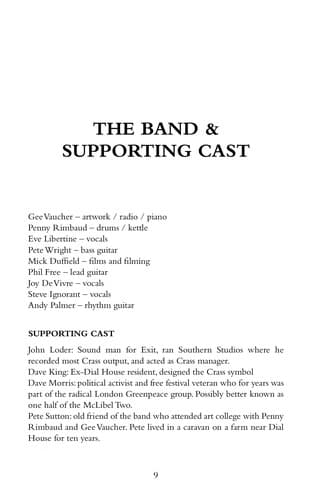
- George Berger: The cynical architect of this biography, a former Sounds journalist who refused to polish the dirt off his subjects.
- Penny Rimbaud: The austere intellectual engine and drummer of Crass, exposed here as a flawed utopian dictator.
- Steve Ignorant: The working-class mouthpiece whose raw vocal delivery gave Rimbaud's manifestos teeth.
- Gee Vaucher: The visionary artist whose stark, confrontational collages defined the aesthetic of a generation.
- Eve Libertine & Joy De Vivre: The essential female voices of Crass, whose contributions Berger heavily underrepresented.
Essential Discography
- The Feeding of the 5000 (1978): The foundational text of anarcho-punk, a brutal assault on religious and state hypocrisy.
- Stations of the Crass (1979): A sprawling, chaotic double album that cemented their status as a genuine threat to the establishment.
- Penis Envy (1981): A fierce, feminist masterpiece that stripped away the macho posturing of the punk scene.
- Christ - The Album (1982): A dense, complex box set that pushed the boundaries of what a punk record could be, both musically and politically.
- Yes Sir, I Will (1983): A visceral, improvised howl of rage against the Falklands War, signaling the beginning of the end for the collective.
Archivist Notes: The Story of Crass: A Brutalist Autopsy of Anarcho-Punk
About The Helter Skelter Archive
We are dedicated to preserving the raw, unfiltered history of rock music. Rejecting modern sanitized narratives, our editorial desk digs into out-of-print fanzines, rare biographies, and the chaotic history of the artists who built the culture. No AI rewrites, no corporate spin.
Join The Underground
Get rare archival footage, out-of-print fanzine scans, and exclusive reviews delivered to your inbox.
No spam. Just pure rock history.