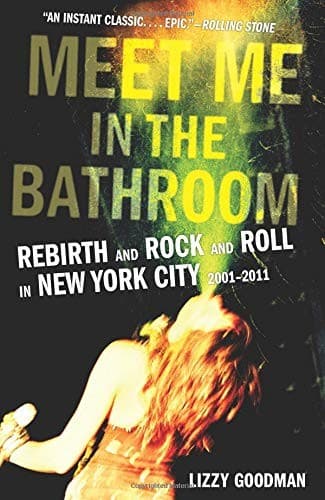
Meet Me in the Bathroom

Meet Me in the Bathroom

A cynical autopsy of New York's last great rock and roll swindle (2001-2011).

HS.UK
Author: The London Archives
Filed: 2017-05-23

The Last Gasp

Lizzy Goodman is not some detached academic observer. She was in the trenches. Moving to New York City at the exact bleeding edge of the millennium, she shared squalid apartments with the kids who would shortly hijack global pop culture. She drank in the same rat-infested dives. Her physical and emotional proximity to The Strokes—the gravitational centre of this entire oral history—powers the engine of the book. This is not journalism in any sterilized, objective sense. It is an act of frenzied, desperate archiving.

New York City in 2001 functioned as a strange, vibrating corpse. The old-guard music industry was a bloated, dying whale, still writing massive checks for mediocre post-grunge music videos. They were entirely oblivious to the fact that Napster had already slipped the knife between their ribs. Then the towers fell. The smoke literally choked the air downtown. Instead of killing the city's youth culture, the horror acted as a high-pressure incubator. People realized they could die on a random Tuesday. So they started bands. They threw illegal warehouse parties. They consumed staggering quantities of cocaine in terrible bathrooms. Williamsburg, Brooklyn, had not yet become a punchline. It was a freezing industrial wasteland where rent was cheap and noise complaints simply evaporated into the smog.

Five wealthy kids with perfect hair and perfect thrift-store leather jackets arrived as a fully formed aesthetic proposition. The Strokes looked like the Velvet Underground, played like Television, and carried themselves with an irritating, brilliant nonchalance. Is This It, released in late 2001, violently shifted the tectonic plates of pop culture. It forced the UK press into a manic frenzy. The NME effectively relocated to Manhattan. The music press needed an antidote to the misery of nu-metal and the sanitized pop of the late nineties. Julian Casablancas provided it, wrapped in cigarette smoke and spilled beer.

Subjective Realities

An oral history is a dangerous, thrilling format. You do not get the truth. You get multiple, violently opposed versions of the truth. Julian Casablancas remembers one thing; Ryan Adams remembers it entirely differently. The friction between these clashing, subjective realities generates the book’s suffocating heat.

The brutal, almost Roman Empire-level politics of coolness form the primary narrative spine. The Strokes sit at the absolute top of the pyramid. Everyone else is merely reacting to them. Interpol’s Paul Banks and Carlos D emerge as ambitious, tightly wound figures who desperately coveted the crown but never achieved the effortless grace of their peers. The revelations regarding Carlos D's descent into ego and excess are grim. He was a caricature of a rock star, wearing a gun holster and refusing to play bass lines that sounded "too rock." Goodman dissects this pretension with ruthless efficiency.

Archive Snapshot

Ryan Adams does not survive this text. Goodman refuses to pull punches. Adams is positioned as a toxic, chaotic interloper. He was the established alt-country darling who gravitated toward the younger, cooler New York bands like a vampire desperate for fresh blood. The book exposes him as a deeply disruptive influence on Albert Hammond Jr. The allegations of Adams fueling Hammond's heroin addiction represent some of the darkest, ugliest passages in the text. Casablancas essentially banished Adams from their inner circle. It is a Shakespearean feud played out in dingy East Village bars.

James Murphy is no hero here either. He is depicted as an older, deeply insecure, manipulative genius. LCD Soundsystem provided the necessary counter-programming to the leather-jacket rock, but Murphy’s control-freak nature alienated almost everyone around him. His relationship with Tim Goldsworthy, the DFA Records co-founder, is examined as a toxic codependency that ended in brutal lawsuits and ruined friendships. Murphy comes off as brilliant but deeply flawed, obsessed with staying relevant as he aged past the prime demographic of the scene he helped invent.

Gender dynamics are equally vicious. The scene was suffocatingly male. Karen O and Kim Gordon highlight the pervasive boy’s club mentality. The book exposes the casual misogyny of the era, where women were frequently relegated to the roles of muses, groupies, or PR girls, unless they possessed the overwhelming, terrifying force of a Karen O. The Moldy Peaches’ Kimya Dawson provides a heartbreaking counter-narrative to the glamorous excess, detailing the emotional toll of being an outsider among outsiders.

The Machine Breaks

Music blogs like BrooklynVegan and Pitchfork completely altered the ecosystem. The book documents the exact moment when the power shifted from established print magazines to anonymous kids with laptops in Brooklyn bedrooms. The hype cycle accelerated to light speed. Bands were destroyed before they even released an album. The Virgins are profiled as a prime casualty of this hyperspeed machine—too much money, too fast, zero substance. The narrative forces the reader to confront how the consumption of music fundamentally broke during this decade. The artists were the canaries in the coal mine of the digital age.

"I remember just thinking, 'I want to be in the Velvet Underground.' That was it. That was the whole plan." — Julian Casablancas, Meet Me in the Bathroom

By putting these stories down in print, Goodman codified a mythology. She cemented the 2001-2011 era as the last great, chaotic gasp of rock and roll before the algorithm took over entirely. She also exposed the myth for what it was: a privileged, exclusionary party fueled by massive advances and major label desperation.

Critics hammered the text for its narrow focus. It is intensely white. It is intensely male. Entire vibrant musical movements happening in New York at the exact same time—the resurgence of underground hip-hop, the Latin explosion—are completely ignored. Goodman wrote about her specific world, but the subtitle, Rebirth and Rock and Roll in New York City, implies a comprehensiveness that simply does not exist. It is the history of a specific zip code and a specific tax bracket masquerading as a universal truth.

The controversies surrounding the book stem directly from its raw, unfiltered nature. James Murphy was reportedly furious about his portrayal. The Ryan Adams sections aged perfectly when the massive wave of abuse allegations against him broke years later. The book functioned as a prequel to his downfall, exposing his manipulative tactics long before the mainstream media caught on.

Gentrification acts as the silent killer in the background. The venues are gone. Brownies is gone. The original Knitting Factory is gone. The idea that a group of broke artists could move to Manhattan and survive on part-time jobs and cheap beer is now a science fiction concept. The musicians in the book were the shock troops of gentrification; they made Brooklyn cool, and then they were immediately priced out by the bankers who wanted to buy the cool.

The final, cynical truth is that the scene achieved exactly what it set out to do, and nothing more. They wanted to be rock stars. They got the clothes, the drugs, and the magazine covers. They did not change the world. They wrote some sharp, unforgettable pop songs, and then the money ran out.

The Personnel

  • Lizzy Goodman: The archivist, the insider, the judge.
  • Julian Casablancas: The reluctant, sneering king.
  • Ryan Adams: The interloper, the villain, the parasite.
  • James Murphy: The insecure genius, the control freak.
  • Karen O: The unstoppable force.
  • Carlos D: The holster-wearing casualty of ego.

Essential Discography

  • The Strokes - Is This It (2001)
  • Interpol - Turn On the Bright Lights (2002)
  • Yeah Yeah Yeahs - Fever to Tell (2003)
  • LCD Soundsystem - LCD Soundsystem (2005)

Archivist Notes: Meet Me in the Bathroom

Absolutely. Written by Lizzy Goodman, this book is considered a monumental piece of literature in the rock archive. It offers unfiltered access to the era and is a must-read for any serious collector.
HS

About The Helter Skelter Archive

We are dedicated to preserving the raw, unfiltered history of rock music. Rejecting modern sanitized narratives, our editorial desk digs into out-of-print fanzines, rare biographies, and the chaotic history of the artists who built the culture. No AI rewrites, no corporate spin.

Join The Underground

Get rare archival footage, out-of-print fanzine scans, and exclusive reviews delivered to your inbox.

No spam. Just pure rock history.