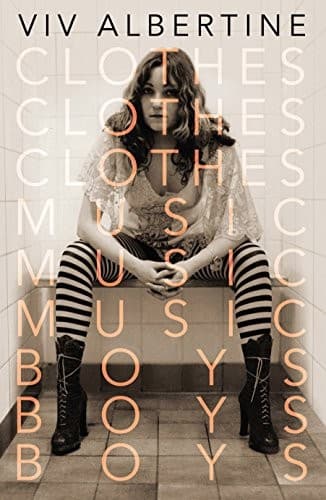
Clothes, Clothes, Clothes. Music, Music, Music. Boys, Boys, Boys.
A brutal, unsentimental dissection of the London punk scene and the agonizing aftermath of survival.
Rock and roll was a rotting corpse by the mid-1970s. Bloated men with excessive hair played twenty-minute guitar solos in stadiums filled with compliant, anesthetized consumers. These audiences were completely detached from the miserable reality of the streets outside. The industry operated as an exclusive gentleman's club. Guitars were sacred phallic symbols, tightly guarded by gatekeepers who demanded formal training and absolute subservience. Young women were expected to be groupies, girlfriends, or silent muses. The system was rigged. You needed a permit to make noise. The establishment was entirely self-congratulatory. It was sick.
Viv Albertine refused to ask for permission. Sydney birthed her, but the suffocating suburban sprawl of London forged her absolute contempt for the rules. She looked at the bloated rock establishment and felt nothing but visceral disgust. The air was thick with the expectation that girls would eventually shut up, settle down, and breed. She bought a Fender Telecaster instead. She did not know how to plug it in. She did not care. It was a declaration of war.
Money was scraped together from a grandmother's inheritance to acquire that first instrument. She did not bother learning traditional scales or agonizing over music theory. She learned how to construct rhythmic violence. Her approach was entirely confrontational. The establishment demanded melody. She offered pure dissonance. The sheer willpower required to stand on a stage when every single male in the room is actively waiting for you to fail cannot be exaggerated. The hostility was a physical weight. She stared them down.
London was choking on its own garbage during this era. The romanticized version of the King's Road sold by revisionist historians is a complete fabrication. The city was crippled by strikes, uncollected refuse rotting in the streets, and severe economic depression. It was grim, violent, and relentlessly cold. The punk ethos was born out of absolute necessity, not some art school thought experiment. You fought for space. You fought for warmth. You fought to be heard over the deafening noise of a collapsing empire.
Squatting provided the only viable architecture for the noise. Sharing dilapidated, freezing buildings with people like Paul Simonon before The Clash ascended to global fame wasn't a fashion statement. It was bare survival. These were hungry, feral kids operating entirely outside the law. They stole electricity from streetlamps. They existed on scraps and adrenaline. The physical environment was incredibly hostile, and the music they created mirrored that exact hostility. Every single chord struck was a desperate attempt to prove they were still breathing.
Sid Vicious was not yet a Camden market t-shirt. He was John Beverley, a mate hanging around the squats, completely unburdened by the cartoonish, tragic mythology that would later consume and destroy him. Albertine's memoir violently strips away the plastic punk iconography. She humanizes the martyrs. She presents a vulnerable, confused kid who was eventually swallowed whole by a cynical industry and a manufactured persona he could not control. He was just a boy. The industry fed him to the dogs.
The Flowers of Romance existed primarily as a rumor. Co-founding this early outfit with Vicious in 1976 set the template for everything that followed in her career. They barely knew how to hold their instruments. It simply did not matter. The intent was everything. They were dismantling the old system brick by crumbling brick. The sheer audacity of standing in a room and making a racket was a radical political act in a society that demanded total silence from its youth.
Then came The Slits. Ari Up, Palmolive, Tessa Pollitt, and Albertine. A group of women who looked at the aggressive machismo of the early punk scene—a scene that rapidly replaced old rules with rigid new uniform codes—and laughed in its face. They absolutely refused to play fast three-chord thrash. They refused to wear the mandated leather jackets. They dismantled expectations from the inside out. The music was a serrated, rhythmic assault. It was highly dangerous.
The Bleach Era
Recording Cut was an act of physical violence. The studio sessions in 1979 were grueling, confrontational, and utterly uncompromising. They isolated themselves in the countryside to escape the sneering scene. The industry expected them to fail. They were women holding guitars. The very act was viewed as a pathetic novelty by the cynical music press. The Slits proved every single detractor violently, unequivocally wrong.
Dennis Bovell understood the assignment. The acclaimed dub producer took their chaotic, raw energy and anchored it with bone-rattling bass frequencies. Ridge Farm Studios in Rusper, England, served as the laboratory for this brutal experiment. It sounded like absolutely nothing else on earth. Not punk. Not reggae. It was a completely new dialect spoken in tongues. The collision of Bovell’s dub sensibilities and Albertine’s scraping, atonal guitar work birthed a terrifying masterpiece. The record bleeds.
Mick Jones haunted the margins of her early ascent. He helped her pick out her first guitar in a rare moment of solidarity. Their relationship was a tempestuous, agonizingly raw collision of fragile egos. Albertine writes about him with a terrifying lack of sentimentality. He was a catalyst, yes, but he was also just a boy caught up in his own rapidly rising stardom. The connection was fractured by ambition and insecurity. Love in the ruins.
Romance in the punk scene was a blunt instrument. The memoir details a pregnancy and a subsequent abortion with flat, unflinching honesty. There are absolutely no apologies. There is no weeping for the camera or pleading for sympathy. She presents the cold, hard facts of survival in an environment that afforded young women zero safety nets. The traditional gender roles were still suffocatingly present behind closed doors, even among the supposed revolutionaries. She smashed through them anyway.
Side Two of the memoir hits like a concrete slab. The music stops abruptly. The industry moves on to the next disposable, highly profitable trend. What happens to a genuine pioneer when the revolution ends? Most rock biographies end with a triumphant stadium tour or a highly publicized, tragic overdose. Albertine gives us the brutal, unglamorous reality of just living day to day. The silence after the applause is entirely deafening. The sheer terror of normalcy sets in quickly.
Twenty-five years of absolute silence followed the collapse of the movement. She completely walked away from the music industry. The guitar went into a case and stayed there. The identity of "punk guitarist" was shed like dead, useless skin. The transition from the feral freedom of the 1970s to the highly structured reality of adult life is documented with agonizing precision. She refused to trade on past glories or sell cheap nostalgia. She became a ghost in her own story.
Directing television for the BBC offered a sterile refuge. She worked extensively for the British Film Institute. She tried desperately to assimilate into the professional middle class. It was an entirely different kind of performance. The corporate structures of television production were just as restrictive, if not more so, than the rigid rules of the major record labels. She endured the suffocating banality of meetings, schedules, and budgets. It was sheer survival, just in a different uniform.
IVF treatments reduced her existence to a clinical medical experiment. The sheer desperation to conceive, the clinical coldness of the hospital procedures, the massive strain it placed on her marriage—it is all laid bare for the reader to dissect. The memoir violently shifts from external cultural rebellion to an agonizing internal struggle. The physical body becomes a brutal battleground. The prose remains incredibly sharp, entirely devoid of self-pity. She documents the failures and the exhaustion with the exact same clinical eye she used to describe chaotic gigs at the Roxy.
The Return
Cancer struck with vindictive, cruel timing. In 1999, just six weeks after the birth of her daughter, Vida, Albertine was diagnosed with cervical cancer. The universe possesses a truly sick sense of humor. The battle for her life eclipsed absolutely everything that came before it. Punk rock was child's play compared to this nightmare. The illness aggressively stripped away her identity, leaving only raw, primal terror and a desperate will to live.
Hospitals rapidly replaced sweaty basement clubs. The sterile white walls, the beeping machines, the constant, suffocating threat of death hanging in the air. She writes about the physical deterioration and the sheer indignity of severe illness with devastating clarity. The pathetic lie that rock and roll keeps you young forever is brutally, systematically exposed. The body fails. The flesh rots. You are entirely alone in the dark. She fought the disease with the exact same stubborn refusal to submit that defined her youth. She survived.
The Vermilion Border proved the silence was only temporary. Released in 2012, her debut solo album wasn't a nostalgic cash-grab engineered by desperate managers. It was a total resurrection. After twenty-five years, she picked up the guitar again. She worked with Adrian Sherwood and other hardened veterans of the dub scene. The music was heavily scarred, older, and infinitely more dangerous. She reclaimed her voice from the ashes of her past. She did not ask for permission this time either.
Clothes, Clothes, Clothes dropped like a live grenade on May 12, 2014. The PR-managed, highly sanitized world of music publishing simply didn't know what to do with it. It was too raw. It was too honest. It exposed the traditional rock autobiography as a masturbatory exercise in ego-stroking. The critical acclaim was immediate, overwhelming, and entirely justified. The Sunday Times and Mojo bowed down. It shattered the tired old mold entirely.
Music books usually function as shallow PR exercises. They are carefully curated lists of chart positions, famous friends, and heavily mitigated regrets. Albertine destroyed that format completely. She proved that a music memoir could be actual literature. It could be a violent bloodletting. She dragged the crucial contributions of women from the margins to the dead center of the historical frame. The narrative of British punk had been monopolized by loud men for decades. She violently corrected the historical record.
Nostalgia is a terminal disease. It softens the hard edges of history. It turns street riots into glossy fashion shoots for Sunday supplements. Albertine actively refuses to participate in this historical revisionism. The controversy surrounding the book stemmed entirely from its unvarnished truth. Aging, comfortable punks bristled at being portrayed as flawed, sexist, or painfully ordinary. The truth is highly offensive when you have spent thirty years hiding behind a leather jacket and a fabricated myth.
"I didn't want to be one of the boys; I wanted to be a girl, but a new kind of girl." — Viv Albertine
Her prose operates with surgical coldness. The unapologetic discussion of abortion, terminal illness, and domestic collapse shattered the boundaries of what a musician is permitted to write about. She demonstrated that fighting for bodily autonomy in a hospital ward requires infinitely more grit than playing a guitar on a stage. The book immediately became a mandatory text. It challenged every lazy archivist to revise their inaccurate notes. The old guard was put on notice.
History always belongs to the people who write it down. Albertine ensured her existence could not be erased by the male-dominated music press. Cut is a foundational document of post-punk. Her guitar playing is heavily studied, not casually dismissed. She outlived the lies of the industry, the collapse of her marriage, and the rot in her own cells. She stared down the void and took precise notes.
We are left with the wreckage. This book makes almost every other memoir in the genre look cowardly, pathetic, and heavily contrived. It is a brutal strike against the act of forgetting. A deeply cynical industry constantly tries to package rebellion into neat, highly profitable boxes. Viv Albertine took a heavy sledgehammer to the box. She told the absolute truth. There are no apologies.
The Personnel
- Viv Albertine - Guitar, Vocals, Defiance
- Ari Up - Vocals, Chaos
- Tessa Pollitt - Bass, Foundation
- Palmolive - Drums, Velocity
- Dennis Bovell - Producer, Dub Architect
- Mick Jones - Guitar, Catalyst
- Sid Vicious - Drums (Flowers of Romance), Casualty
Essential Discography
- Cut (The Slits, 1979)
- Return of the Giant Slits (The Slits, 1981)
- The Vermilion Border (Viv Albertine, 2012)
Archivist Notes: Clothes, Clothes, Clothes. Music, Music, Music. Boys, Boys, Boys.
About The Helter Skelter Archive
We are dedicated to preserving the raw, unfiltered history of rock music. Rejecting modern sanitized narratives, our editorial desk digs into out-of-print fanzines, rare biographies, and the chaotic history of the artists who built the culture. No AI rewrites, no corporate spin.
Join The Underground
Get rare archival footage, out-of-print fanzine scans, and exclusive reviews delivered to your inbox.
No spam. Just pure rock history.